Showing posts with label Karl Marx. Show all posts

Sunday, November 5, 2023

Karl Marx & His Ideology

Overview  


Karl Marx was a German philosopher, economist, historian, sociologist, and political theorist who is best known for his influential works, "The Communist Manifesto" and "Das Kapital." His ideology, Marxism, focuses on the class struggle between the working class and the ruling class in capitalist societies. 
 
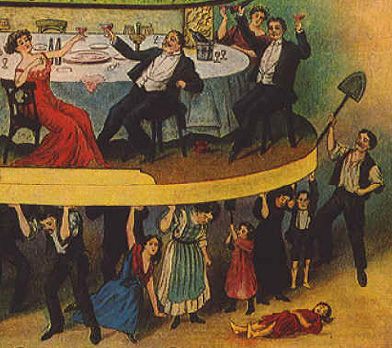
Marx argued that capitalism creates social inequality, alienation, and exploitation. He believed that these inherent contradictions within capitalism would eventually lead to its downfall and be replaced by a classless society known as communism. In this communist society, the means of production would be collectively owned and controlled by the people, ensuring equality, and eliminating class divisions.
 
Marx also analyzed historical materialism, which suggests that social change is driven by the development of productive forces and conflicts between different social classes. He believed that history progresses through stages, from feudalism to capitalism and eventually communism. 
His work has inspired political movements and revolutions around the world Marx identified the present as a part of history. So, he introduced different economic theories to convince his ideology. 

  • Marx's Methodology  
  • Commodities and Classes 
  • Marx's Labor Theory  
  • Surplus and Exploitations 

In summary, Karl Marx's comprehensive insights into economics, social dynamics, and historical evolution continue to shape the discourse around class struggle, equality, and societal transformation. His theories have resonated across the globe, inspiring both contemplation and action, making his legacy an enduring cornerstone in the study of modern society and its possibilities.


Written By: Ishini De Silva


References: 

Encyclopedia Britannica. (n.d.). Karl Marx. Encyclopedia Britannica. Retrieved August 19, 2023, from https://www.britannica.com/biography/Karl-Marx

Investopedia. (n.d.). Karl Marx. Investopedia. Retrieved August 19, 2023, from https://www.investopedia.com/terms/k/karl-marx.asp


Karl Marx [1818 - 1883]


  - A philosopher, author, social therapist, and economist. A hugely influential revolutionary thinker and philosopher as well. He is famous for his theories about capitalism, socialism, and communism. 

  - His writings served as the foundational framework for the development of contemporary international communism.

   Born: May 5, 1818
  Died: March 14, 1883 

- Writings: 

The Communist Manifesto

Das Kapital


The Communist Manifesto


Marx’s Methodology

Karl Marx's a figure in philosophy, sociology and economics established an approach to understanding society and History through his methodology. He developed two main major methodologies: 

  • Historical Materialism  
  • Dialectical Materialism

These methodologies contained the Materialist and Dialectical philosophies which are used to describe the interplay of economic forces, social classes, and historical changes. Historical Materialism describes the social change that is primarily driven by changes in material conditions of production. And Dialectical Materialism derived from Hegelian Dialectics, describes the role of conflict and contradiction within the material world, particularly within the economic and social world.


References 

https://triumphias.com/blog/methodology-karl-marx/

Marx’s Method Of Political Economy, Filipe Duarte | February 5, 2019


Commodities and Classes: Unraveling the Essence of Capitalism by Karl Marx


  In Karl Marx's economic philosophy, his exploration of "Commodities and Classes" serves as a critical focal point. Accordingly, that can uncover the essence of capitalism's dual-class structure and the pivotal exchange dynamics between capitalists and the proletariat...

The Core Tenets

Capitalism's Class Divide: Marx's analysis begins with the stark division between capitalists, who own the means of production, and the proletariat, individuals who offer their labor for sale in the market. This separation of labor from the means of production forms the bedrock of capitalism.

The Exchange Nexus: At the heart of Marx's theory lies the wage bargain, a fundamental transaction between capitalists and the working class. This exchange is pivotal in determining not just wages but the dynamics of power and exploitation within the capitalist system.

Commodity Prices and Exchange Values

Unveiling the Labor Theory of Value: Contrary to conventional economic theories that begin with the price of commodities, Marx's focus was on understanding the forces shaping commodity prices. His labor theory of value posits that prices reflect the socially necessary labor time embedded in a product.

Wages as a Contradiction: Marx considered wages the linchpin of capitalism because they reveal a fundamental contradiction within the system. Wages, as a form of price, capture both quantitative (e.g., exchange ratios) and social relationships between capitalists and the proletariat.

A Shift in Production Paradigm

Use Value vs. Exchange Value: Marx discerns a pivotal transformation in capitalism where commodities shift from being produced for their use value (direct consumption) to their exchange value (exchange in the market). This shift underscores the capitalist mode of production.

The Dual Nature of Prices

Quantitative and Social Relationships: According to Marx, commodity prices embody two dimensions: quantitative relationships between commodities (e.g., exchange ratios) and social relationships between individuals within the economy. Wages, as a price, encapsulate both aspects, offering a window into the intricate social fabric of capitalism.

In essence, Marx's exploration of "Commodities and Classes" isn't merely an economic inquiry but a sociopolitical revelation. It unveils the power dynamics, exploitation, and class struggle inherent in capitalism. Marx's work continues to resonate, providing insights into the complexities of the capitalist world and the enduring relevance of understanding commodities and classes in contemporary society.

Written By, Gimhani Geethika Satharasinghe

References

Landreth, H., & Colander, D. (2002), History of Economic Thought (4th ed.), Houghton Mifflin Company.

Karl Marx’s Labor Theory of Value

Marx’s Labor Theory of Value

A leading political philosopher and economist, Karl Marx introduced the labor theory of value as a central concept in his critique of capitalism. 

This theory holds that,

The value of a commodity is determined by the amount of labor time required in life to produce it. 

Unlike classical economists such as Adam Smith and David Ricardo, who focused on supply and demand, Marx argued that utility does not depend on utility or scarcity.

The basic elements of Marx’s value theory of labor can be distilled into two types of labor: 

  1. Absolute labor: The expenditure of physical effort in the production of goods 
  2. Intangible labor: One factor in the total labor capacity of human beings and is the mother of this intangible labor it ultimately determines the price of the commodity.


 Nevertheless, Marx’s labor theory of value remains a central concept in Marx’s economic thought. It draws attention to the inherent conflict between labor and capital, providing a lens for understanding class struggle and social change. While critics may question its application to contemporary economics, its basic principles are still helpful in exploring issues of power dynamics, economic efficiency, and social justice.


IN TODAY'S' CONTEXT:


In conclusion, Karl Marx’s labor theory of value offers a unique perspective on commodity prices. By incorporating the value of labor and class struggle, the theory demonstrates the value of capitalist systems. Despite criticisms of its objectivity and adaptability to contemporary economic realities, it is influential in contemporary debates about income distribution, labor rights, and critiques of capitalism.

 Written By: Anomi Weerakoon


Summary of the Article


References: 

1.   (Marx, 1867)

2.   (Marx, Theories of Surplus Value, 1861–1863)

3.  (Smith, 1776)

4. (Ricardo, 1817)


Saturday, November 4, 2023


 References

Landreth, H., & Colander, D. (2002), History of Economic Thought (4th ed.), Houghton Mifflin Company.

Nilsen, A. G. (2020, November 23). Marx on exploitation: an ABC for an unequal world. openDemocracy. https://www.opendemocracy.net/en/beyond-trafficking-and-slavery/marx-exploitation-abc-unequal-world/

https://mronline.org/wp-content/uploads/2018/12/10-Labour-Rights-Murals-Widewalls-widewalls.ch-.jpg


Karl Marx on Capitalism

Capitalism and Karl Marx are two closely related topics. Let's explore each of them:

1. Capitalism:

Definition: Capitalism is an economic and social system characterized by private ownership of the means of production (such as factories, land, and resources) and the pursuit of profit. In a capitalist system, the allocation of resources and the distribution of goods and services are primarily determined by market forces, supply and demand, and competition.


Key Features of Capitalism:


2. Karl Marx:

Let’s see what the key elements of Karl Marx on Capitalism are.

1.     Perfect Capitalism

2.    The Value of Labor

3.    Profits and Unemployment

4.    The Consequences of Innovation

5.    Commoditization

6.    The Gulf Between Rich and Poor

7.    Beyond Capitalism, What?

8.    Flaws and Virtues of Marxist Theory


These elements are further explained in the below flowchart more elaborately.


Key Ideas of Karl Marx: (in a nutshell...)


The relationship between capitalism and Karl Marx is one of critique and opposition. Marx's work provides a critical perspective on the functioning of capitalist systems and their implications for social and economic inequality. 

Practical world usage of Karl Marx's Theories


Conclusion and Modern Relevance of Marx’s Ideology

As they continued their conversation, the two young individuals, Karl and Friedrich, couldn't help but ponder how Karl Marx's ideas were finding resonance in the modern world. Discussions about wealth inequality, labor rights, and social justice continued to echo his ideologies in the 21st century. Their unexpected reunion in this new era reminded their shared commitment to a world where fairness and equality would define the path forward.


Written By; Ishini De Silva