Showing posts with label Evolution of Economic Thought. Show all posts

Sunday, November 5, 2023

Pre Modern Economic Thought


Introduction

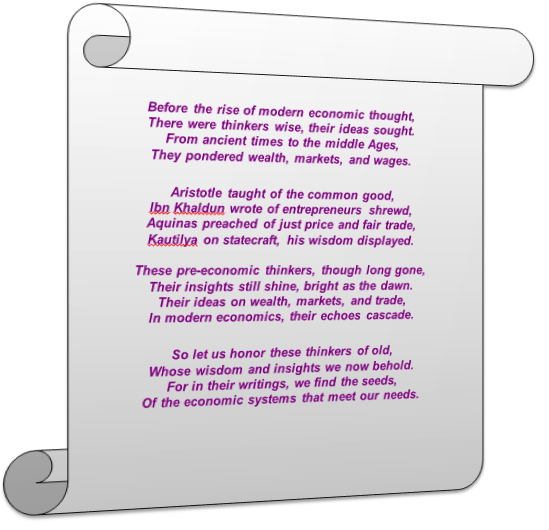
Pre-economic thought refers to the economic ideas and concepts that were developed before the emergence of economics as a distinct academic discipline. This period spans from ancient times to the late 18th century and encompasses a wide range of cultures and civilizations.

  • Premodern Economic thought was existed in the 18th century, before the emergence of the modern economic thought. It focused on the ideas and practices of ancient civilizations like Greece, Rome, China, India, Iraq and British.
  • Premodern economic thought was mainly on the concerns with issues of production, consumption and distribution of products and it was heavily influenced by the religious and moral values. 

Due to the religious and moral influences prevailed in the society economic activities were classified as morally or ethically justifiable or unjustifiable. Specially, we can mention Catholic religion, Islamic concept of Zakat and so on as the religious influences which had played a crucial role in shaping the economic thought.


Under Pre modern economic thought, the era has been classified to main six (6) parts such as Greek Economic Thought, Roman Economic Thought, Indian Economic Thought, Chinese Economic Thought, Islamic Economic Thought and finally the British Economic Thought.


Under these each classification we can learn few personalities who have greatly contributed to the development of Economic Thought.

These personalities will be discussed in detail manner with upcoming blog posts.
Written by: Dinithi Jayasuriya & Dismi HansikaREFERENCEShttps://shorturl.at/lyDH6

Friday, November 3, 2023

Greek Economic Thought


Hesiod

Period: 8th century

Occupation: Poet, Philosopher, Farmer, Mythmaker

Main focusing areas and contributions to the economy :   

  • Agricultural productivity
  • Fair trade
  • Ethical conduct
  • Diligent labor for economic growth

Works and Days

Hesiod offers advice on how to lead a virtuous and prosperous life, including guidance on agriculture, trade, and labor. One of the central themes in Hesiod's economic thought is the importance of hard work and diligence in achieving economic success.

Agriculture

Right timing and proper observance of natural cycles

Hesiod emphasizes the significance of the right timing and proper observance of natural cycles for agricultural activities. He highlights the necessity of understanding the seasons, weather patterns, and celestial signs to engage in successful farming. This demonstrates his belief that a strong agricultural foundation is essential for economic stability and prosperity.

Importance of fair trade and ethical conduct

Furthermore, Hesiod stresses the importance of fair trade and ethical conduct in economic activities. He cautions against dishonest practices such as deceit, fraud, and exploitation. Hesiod encourages individuals to engage in fair exchanges and to treat others justly, as he believes that unethical behavior will ultimately lead to negative consequences.

The concept of labor and its role in economic growth

Hesiod also discusses the concept of labor and its role in economic growth. He promotes the idea that hard work is essential for achieving wealth and prosperity. Hesiod advises individuals to engage in productive activities rather than indulging in idleness or laziness. He argues that diligent work leads to self-sufficiency and a stable economic condition.

Overall, Hesiodic economic thought emphasizes the importance of agricultural productivity, fair trade, ethical conduct, and diligent labor for achieving economic success. While these ideas may seem simplistic by modern standards, they provide valuable insight into the economic mindset of ancient Greece and contribute to our understanding of early economic thought.

Xenophon 

Period : 4th century

Occupation :  Philosopher, Historian, Soldier  

Main focusing areas and contributions to the economy :

  •      Economicus
  •       Importance of self-efficiency
  •        Importance of agriculture as a fundamental economic activity
  •        Role of education in economic success
  •        Mutually beneficial exchange

 Oeconomicus

He is known for his wide range of works, including his economic treatise titled "Oeconomicus." Xenophon's economic thought focuses on the management of household and estate affairs, offering practical advice on how to achieve economic prosperity.

In "Oeconomicus," Xenophon presents a dialogue between Socrates and a wealthy Athenian named Critobulus. The conversation revolves around the topic of household management, with an emphasis on agriculture and the proper management of resources.

Self Sufficiency

One of the key principles in Xenophon's economic thought is the importance of self-sufficiency. He argues that individuals should strive to manage their households and estates in a way that minimizes dependence on others. Xenophon believes that self-sufficiency leads to economic stability and security.

Agriculture

Xenophon also emphasizes the importance of agriculture as a fundamental economic activity. He highlights the need for proper cultivation of land, efficient use of resources, and effective organization of labor. Xenophon suggests that a well-managed agricultural estate can generate surplus produce, which can be used for trade and further economic growth.

Role of education in economic success

Furthermore, Xenophon discusses the role of education in economic success. He argues that individuals should be knowledgeable about various aspects of household management, including agriculture, finance, and administration. Xenophon believes that education and practical skills are essential for effective economic decision-making and resource allocation.

Mutually beneficial exchange

In terms of trade, Xenophon advocates for fair and honest practices. He encourages individuals to engage in mutually beneficial exchanges and to avoid deceitful or exploitative behavior. Xenophon's emphasis on ethical conduct in economic activities aligns with his broader philosophy of leading a virtuous life.

Overall, Xenophon's economic thought centers around the principles of self-sufficiency, efficient agricultural management, education, and fair trade. His ideas provide insights into the economic mindset of ancient Greece and offer practical advice on how to achieve economic prosperity through responsible household management.


Written By: Isuri Sumodya & Dinithi Jayasuriya


References

https://www.athensjournals.gr/business/2022-AJBE-Papanikos-Hesiod-02.pdf

https://www.123helpme.com/essay/Xenophons-The-Economist-248807#:~:text=Xenophon%20in%20his%20economic%20writing,stable%20and%20well%2Dmanaged%20economy


Thursday, November 2, 2023

Greek Economic Thought

Plato


Ancient Greek philosopher 

(427 to 347 BC)    

He was a student of Socrates and the teacher of Aristotle and is considered one of the most influential figures in western philosophy. Plato’s philosophy focusses on the nature of reality and the pursuit of knowledge.


Main focusing areas and contributions to the economy:

  •  Ideal State:

Plato's most famous work, "The Republic," presents his concept of an ideal state, known as the "kallipolis." In this utopian society, Plato emphasizes the importance of justice and the division of labor. He suggests that the state should be organized into three classes: the rulers (philosopher-kings), the guardians (soldiers), and the producers (craftsmen, farmers, etc.). This division of labor ensures harmony and efficiency within society.

  • Centralized Planning:

Plato advocated for centralized planning and control over economic activities. He believed that the state should be responsible for organizing production, distribution, and consumption. Plato argued that economic decisions should be made by philosopher-kings who possess wisdom and knowledge to ensure the welfare of the entire society.

  • Communism of Property:

Plato proposed a system of communal property in his ideal state. According to his vision, private ownership of property would lead to inequality and conflict. Instead, he advocated for the abolition of private property and the establishment of communal ownership, where all citizens would have equal access to resources.

  • Critique of Trade:

Plato was critical of trade and commerce. He believed that engaging in commercial activities could corrupt individuals and distract them from pursuing higher virtues. Plato considered trade as an unnecessary pursuit that promotes greed and materialism.

  •  Money as a Means, not an End:

Plato viewed money as a mere means of exchange rather than an end in itself. He emphasized that wealth should be pursued for the sake of fulfilling one's needs and contributing to the well-being of society, rather than accumulating it for personal gain.

It is important to note that Plato's economic ideas were primarily focused on the functioning of his ideal state and the role of economics within it. While his ideas may not directly align with modern economic theories, they have contributed to the development of economic thought and continue to be studied and debated by scholars.

Philosopher of old, with wisdom bright,
Your economic thought, a guiding light.
You taught of justice, harmony, and good,
Where all in society understood.

From the Republic's pages, your ideas flow,
Of specialization, markets, and how they grow.
You saw the value of each skill and trade,
And how commerce could benefit all, not just a few.

O Plato, your insights still inspire,
As we strive to build an economy fair and wise.
Where all can thrive, and prosperity bloom,
In a world that values justice and wisdom's boon.


Written By :  Isuri Sumodya  & Dismi Hansika

References

https://www.britannica.com/biography/Plato

https://iep.utm.edu/plato/


Sunday, October 29, 2023

 Aristotle: a Greek philosopher and Scientist

(384 to 322 BCE)


Born: 384 BC in Stagira, Greece 

Died: 322 BC in Chalcis, Greece 

Education: Student of Plato at the Academy in Athens 

Writings: Wrote on a wide range of topics, including philosophy, logic, physics, metaphysics, ethics, politics, poetics, and rhetoric

Aristotle made significant contributions to various fields including philosophy, logic, ethics, biology, physics, politics, and metaphysics. His works cover a wide range of topics and have had a profound influence on Western thought.

Aristotle's economic thought is centered around the ethical and social dimensions of economic activity. Here are the key aspects in detail:

Ø  Justice:

Aristotle believed that economic activity should be guided by principles of justice. He emphasized the importance of fairness in the distribution of wealth and resources. According to him, economic transactions should be based on mutual benefit and should not exploit or harm others. 

Ø  Moderation:

 Aristotle advocated for moderation in economic pursuits. He believed that excessive accumulation of wealth is detrimental to individuals and society. Instead, he emphasized the importance of finding a balance between material wealth and the pursuit of virtue and well-being.

Ø  Common Good:

Aristotle believed that economic activities should contribute to the common good and promote the overall well-being of society. He argued that economic decisions should be made with the aim of improving the quality of life for all members of society, rather than just benefiting a few individuals.

Ø  Self-Sufficiency:

 Aristotle emphasized the importance of self-sufficiency and the development of productive skills. He believed that individuals should strive to be self-reliant and contribute to the economic well-being of their communities. He saw economic activity as a means to fulfill basic needs and promote social cooperation.

Ø  Role of the State:

Aristotle argued that the state should play a role in preventing wealth concentration and promoting shared prosperity. He believed that the government should intervene in economic affairs to ensure fair distribution of resources and prevent exploitation. However, he also cautioned against excessive state control, emphasizing the need for a balance between individual freedom and collective responsibility.

 Overall, Aristotle's economic thought focuses on the ethical and social dimensions of economic activity. He emphasizes justice, moderation, and the pursuit of the common good as guiding principles for economic decision-making. His ideas continue to influence discussions on distributive justice and the role of the state in modern economics.

O Aristotle, sage of Greece,
Your economic thought, a gift of peace.
You taught that wealth is not the goal,
But rather, to live well and whole.

You saw the value of exchange,
And how it fuels the market's range.
But warned of greed and its dark sting,
That can to ruin's depths us bring.

You taught of moderation's key,
And how to live in harmony.
To use our wealth to serve the good,
And build a world where all are understood.

O Aristotle, your wisdom guides,
As we navigate economic tides.
May we heed your ancient call,
To create an economy for all.

Written by: Buddhin Waidyanatha


References:

 (Purohit, 2019)

(wikipedia, n.d.)

Saturday, October 28, 2023

Roman Economic Thought 


The Romans' emphasis on agriculture, trade, and economic law helped to lay the foundation for modern economic thought. They were also expert engineers and builders and created a sprawling system of roads, bridges, and aqueducts, which helped to support trade. Agriculture was another prominent feature of Roman economic thought, and they cultivated advanced agricultural techniques. Roman merchants were skilled, expanding a trading network across the Roman Empire and connecting it to the rest of the world. The Romans made valuable contributions towards creating economic law. They created a sophisticated legal framework to govern all aspects of the economy, from contracts to property and bankruptcy. 


Saint Thomas Aquinas 


Saint Thomas Aquinas (1225–1274) was a well-known Dominican friar and philosopher widely regarded as among the most influential thinkers due to his comprehensive learning and sophisticated philosophical and theological concepts. He believed that the economy should be organized in a way to promote the common good.  Precisely, the economy should be based on justice and charity to provide for all people's basic needs. 


His Christian beliefs influenced Aquinas’ economic thinking, and he argued that the economy should have been formed with an aim to serve the common good. He was influential in shaping modern economic thought on such topics as just price, private property, trade, and interest. 

O Saint Thomas Aquinas, wise and true,
Your economic thought inspires anew.
You taught that justice guides the way,
And markets serve the common good each day.

You saw that money is a tool,
To trade and grow, not just a rule.
That prices should be fair and just,
And workers paid their rightful trust.

You warned of greed and avarice,
And urged us to share with those in need.
To use our wealth to help the poor,
And build a world where all are sure.

O Saint Thomas, your wisdom shines,
In markets just and hearts aligned.
May we follow your guidance true,
And build an economy that's good for all, it's true.

The just price: In Aquinas’ view, The just price was the value of the good or service such that both buyer and seller were treated fairly. He contended that the just price should be established around the cost of production plus a reasonable profit. 


Private Property: Aquinas believed that private property is a natural right and should be held based on the natural law to promote economic activity equitably. But he said that private property must be used for the common good. That is to say that landowners are not supposed to engage their land harmfully. 


Trade: Aquinas saw business as a force for good since it enabled citizens to concentrate on their own pursuits while exchanging goods and services with different individuals, creating economic growth and prosperity. He believed in promoting trade while letting the free market function as much as possible.


Interest (usury): He argued that charging interest on a loan was justifiable when it compensated the lender for their opportunity cost, essentially covering the loss of potential earnings. But he was absolutely against usury when it came to taking advantage of poor borrowers with outrageous interest rates, as he believed such practices were immoral because they went against the principles of justice and fairness.


St. Thomas Aquinas’ Ideas continue to cast an impressive and lasting shadow on modern economic theory in Roman economic thought. He introduced moral concerns to bear upon exchange in his notion of the ‘just price,’ which resonates with contemporary discussions about fair pricing and corporate social responsibility. Aquinas’s endorsement of private property rights and social responsibility seems congruent with contemporary discussions about property rights and wealth distribution. His policy positions on trade emphasized the importance of economic growth through globalization and trade policies. Furthermore, Aquinas's ethical stance against usury influenced the development of responsible lending practices and financial regulations, reflecting the enduring relevance of his ideas in shaping an ethical modern economic system.


Written by: Tharushi Ponnamperuma 


References: 

https://www.britannica.com/biography/Saint-Thomas-Aquinas 

https://plato.stanford.edu/entries/aquinas/


Thursday, October 26, 2023

 Fan Li

·         Name: Fan Li (范蠡)
·         Nationality: Chinese
·         Occupation: Economist
·         Period: 5th century BC
·         Accomplishments:Advised the King of Yue on how to defeat the King of Wu &Became a successful businessman after retiring from public life
 Fan Li's Economic Thought

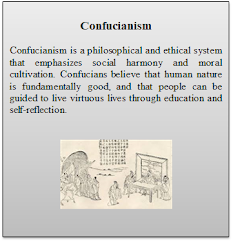
Fan Li's economic thought was a synthesis of Legalism and Confucianism. He believed that the state should play a strong role in the economy, but that this role should be guided by moral principles.


The Legalist-Confucian Dichotomy  

Fan Li was able to balance the need for strong government and strict laws with the need for social harmony and moral cultivation. This synthesis allowed him to achieve significant economic success in the state of Yue. 

Here are some other Fan Li's key economic thoughts:

  • Mutual benefit: The government and the people should work together to create a prosperous society.
  • Economic growth: The government should promote economic growth through policies such as land reform, trade, and commerce.
  • Protecting the poor: The government should protect the poor and vulnerable from exploitation.
  • Fairness: The government should ensure that all people have equal opportunities to participate in the economy.

 Oh, Fan Li, master of wealth,

Your wisdom guides us to this day.
You taught us to share and to care,
To grow the economy in a way
That benefits all, not just the few.

You said, "Water flows from high to low,
And wealth should flow from rich to poor."
You showed us how to create abundance,
How to balance supply and demand,
And how to ensure that everyone has enough.

Your insights are as relevant today
As they were when you first spoke them.
In a world where inequality is rife,
Your words offer us a beacon of hope.

Contemporary Perspective


 Conclusion

Fan Li was a brilliant economist and statesman who was able to achieve significant economic success by combining the best of Legalism and Confucianism. His economic thought can still offer valuable insights for policymakers today.


Written by

Shainy Whittall

References

(vibrant, 2019)

(wikipedia)


Tuesday, October 24, 2023


Muslim Economic Thought


The contribution of Muslims in the field of economics dates back to the early days of Islam, spanning from the 7th century to the 18th century. The Islamic era laid the foundation for economic ideas through the Quran's teachings and the Prophet Muhammad's traditions. 

Central to Muslim economic thought emphasizes justice, ethical conduct, Contributions to economics and finance, and support for free markets. The concept of Zakat, obligatory almsgiving, exemplifies a commitment to addressing economic inequality. Islamic finance, with its prohibiting usury and emphasis on fair trade, showcases a sophisticated approach to economic practices. The early Muslims' engagement in trade and their advancements in science and technology further contributed to the development of economic thought, leaving a lasting legacy that continues to influence economic discourse today.


 There was main 3 personalities.


1. Prophet Muhammad 

Born: 29 August 570 AD, Mecca

 Died: June 8, 632 AD, Medina

Oh, Prophet Muhammad, the seal of the prophets,
Your economic thought was truly profound.
You taught us to share our wealth with the poor,
And to live within our means, never bound.

You encouraged trade and commerce,
And showed us the importance of hard work.
You taught us to be honest and fair in our dealings,
And to never exploit the weak or the poor.

Muhammad was an Arab religious, social, and political leader and the founder of Islam.

He brought ideas about,

       Control over lending -

Muhammad advocated ethical lending practices, discouraging usury and exploitation in financial transactions. His teachings emphasized fairness, compassion, and the well-being of individuals, fostering a community that prioritized economic justice and responsible lending. 

      Reform corrupt market practices

Prophet Muhammad spearheaded reforms against corrupt market practices, promoting transparency, honesty, and fair dealings in commerce. His teachings sought to eradicate fraudulent practices, ensuring a just and ethical marketplace where transactions were conducted with integrity. 

      Systematic transfer of funds in favor of the poor

Prophet Muhammad implemented a systematic transfer of funds to support the impoverished, exemplified through the institution of Zakat, a mandatory almsgiving. This compassionate economic system is aimed at addressing social inequality by redistributing wealth and ensuring the well-being of the less fortunate in the community.


2. Abu Yusuf

Born: 661 AD· Kufa, Umayyad Caliphate

Died: 750 AD· Baghdad, Abbasid Caliphate


Abu Yusuf, the great jurist and economist,
Your contributions to economic thought are vast.
You wrote about taxation, public finance, and trade,
And your insights are still relevant today.

You argued that the government should play a role in regulating the economy,
And that it should provide social welfare for the poor and needy.
You also emphasized the importance of private property rights,
And the role of the market in promoting economic growth.

Abu Yusuf was a prominent 8th-century Islamic jurist and chief judge.

Abu Yusuf made a significant contribution to economic thought with his work on land taxation, outlined in "Kitab al-Kharaj." This influential treatise reflects his commitment to fostering fairness and justice within the Islamic legal system, providing practical guidelines for revenue collection and contributing to the broader understanding of economic governance in Islamic societies.


3.Ibn Khaldun 


Ibn Khaldun, the great historian and economist,
Your work on economic thought is truly groundbreaking.
You were the first to identify the cyclical nature of economic growth,
And you explained the role of institutions in economic development.

You also emphasized the importance of education and human capital,
And you argued that social cohesion is essential for economic prosperity.

Ibn Khaldun was a 14th-century Arab historian, philosopher, and scholar.

According to economic theorist Ibn Khaldun, the division of labor brings manifold benefits by stimulating supply and demand. As specialization increases efficiency, it positively influences economic growth and development. Ibn Khaldun recognized the pivotal role of supply and demand in determining the prices of goods, acknowledging their impact on the overall economic. 

landscape. He delved into the determinants of economic development, highlighting the interconnected factors of population growth, human capital development, and technological advancements. Ibn Khaldun posited that population growth was intricately linked to a society's wealth. Additionally, he explored the concept of taxation, observing that while short-term revenue increases with higher tax rates, there exists a critical tipping point where excessively high tax rates can lead to a decrease in tax revenues in the long term, as they impose a burdensome cost on producers within the economy.


Written by: Dinithi Jayasuriya, Pasan Rathnayaka, Tharushi Ponnamperuma


References

9ways Academia. (n.d.). From Abu Yusuf Ya'qub idan Ishaq Al Kindi.

britannica. (n.d.). Muhammad biography history & facts.